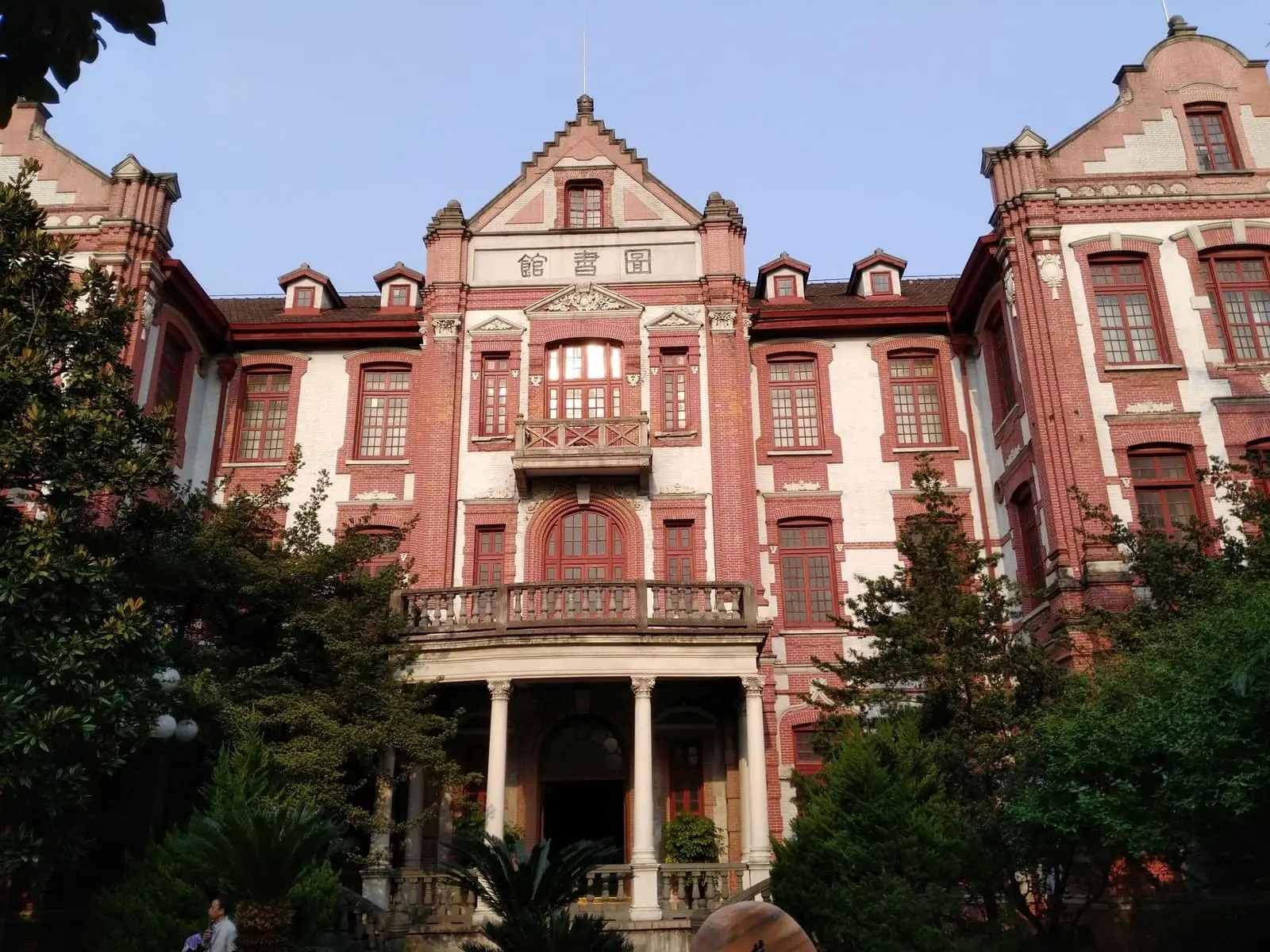
Why study at a university in China?
Over the last twenty years China has become one of the world's largest research centres, and its universities climb the rankings every year. This page explains why to study in China, with sourced figures and current data from our partner universities.
Photo: Nrwt1999 · CC BY-SA 4.0- Chinese universities in QS 2027
- 85 32 of them are our partners
- bachelor's programmes
- 1,921 191 taught in English
- annual tuition
- 13,800 ¥ from
01Universities rising worldwide
China has invested heavily in science and technology over the past two decades. The results are most visible at its universities, where laboratories, scholarships and international programmes expand every year.
It was ¥245 billion in 2005. R&D rose from 1.34% to 2.8% of GDP and passed the OECD average for the first time in 2025.
Source: National Bureau of Statistics of China (2006), National Bureau of Statistics of China (2026)China leads the world with 73,718 applications. Huawei was the top filing company for the ninth year in a row (7,523).
Source: WIPO PCT Yearly Review 2026Nine of the ten academic institutions producing the most high-quality research are in China. Our partners Shanghai Jiao Tong, Nanjing and Sichuan rank 4th, 8th and 9th.
Source: Nature Index 2026 Research LeadersStudents from about 200 countries study in China, almost twice the 2021 low.
Source: ICEF Monitor (2026)Our partner universities in the QS 2027 rankings
The QS World University Rankings rank more than 1,500 universities worldwide on academic reputation, employer reputation, research impact and internationalisation.
85 universities from mainland China are ranked in QS 2027; 32 of them are our partners, and 17 of those are in the top 500. The top 100 are highlighted. "=" means a tied rank. Source: QS World University Rankings 2027
All partner universities →| QS 2027 | University |
|---|---|
| 36 | Shanghai Jiao Tong University (SJTU)Shanghai |
| =90 | Nanjing UniversityNanjing |
| =165 | Wuhan UniversityWuhan |
| =235 | Tianjin University (TJU)Tianjin |
| =237 | Beijing Normal UniversityBeijing |
| 243 | Beijing Institute of Technology (BIT)Beijing |
| =296 | Xi'an Jiaotong University (XJTU)Xi'an |
| =300 | Sichuan UniversityChengdu |
| 307 | Huazhong University of Science and Technology (HUST)Wuhan |
| =309 | Shandong UniversityJinan |
02Affordable costs
At our partner universities, annual tuition for bachelor's programmes ranges from 13,800 ¥ to 180,000 ¥, with a median of 22,000 ¥. Tuition depends on the university, programme and teaching language; medicine and some international programmes cost more.
Monthly living costs excluding housing are estimated at about 2,550 ¥ – 4,050 ¥ in the largest cities (Beijing, Shanghai, Guangzhou) and about 1,730 ¥ – 3,000 ¥ elsewhere. Campus housing, at the fees universities publish, is usually cheaper than renting off campus.
03Study in English or Chinese
Our partner universities offer 1921 bachelor's programmes: 191 taught entirely in English and 1730 in Chinese. English-taught programmes ask for IELTS/TOEFL, Chinese-taught ones for an HSK certificate. If you don't speak Chinese, you can apply directly to an English-taught programme, or do a language foundation year first and then move to a Chinese-taught one.
04Scholarships
The Chinese Government Scholarship is a full scholarship covering tuition, housing, a monthly stipend and health insurance. City and university scholarships are also available.
- Chinese Government Scholarship: embassy channel
Full scholarship: tuition waiver, free dormitory or housing allowance, monthly stipend (CNY 2,500 bachelor's, 3,000 master's, 3,500 doctoral) and medical insurance; international airfare not included. Age limits: under 25 for bachelor's, under 35 for master's, under 40 for doctoral. Bachelor's applicants need a CSCA score report; Chinese-taught master's and doctoral applicants need HSK 4. Apply on campuschina.org following the Chinese embassy's timetable in your country.
Source: Chinese Embassy (2026/2027 CGS notice) - Chinese Government Scholarship: university channel
For master's and doctoral students only (Chinese University Program). You apply directly to a participating university, and it is also a full scholarship. Applications usually run from early January to early April; each university sets its own deadline.
Source: Campus China: Chinese University Program - Provincial and city scholarships
Some local governments fund their own scholarships. The Beijing Government Scholarship, for example, has three categories: A (tuition, housing, living costs and insurance), B (tuition, housing and insurance) and C (tuition and insurance). You apply directly to a university in Beijing.
Source: Beijing Municipal Government (2026) - University scholarships
Many universities offer their own scholarships or tuition discounts; amounts and conditions vary. A Chinese Government Scholarship holder cannot hold another scholarship from the Chinese government or the university at the same time (one-off awards excepted).
Source: Study in Beijing: university scholarships, Chinese Embassy (2026/2027 CGS notice)
05Technology, industry and careers
China is now among the world leaders in electric vehicles, telecommunications, high-speed rail and space technology. Many of our partner universities are where these industries train their engineers.
Electronics, telecommunications and software
5G, chip design, artificial intelligence and communications. Long-established schools that have trained engineers for the telecommunications industry for decades.
University of Electronic Science & Technology of China (UESTC) · Xidian University · Beijing University of Posts and Telecommunications · Huazhong University of Science and Technology (HUST)
Automotive and electric vehicles
Vehicle engineering, batteries and energy systems, intelligent transport.
Beijing Institute of Technology (BIT) · Tianjin University (TJU) · Dalian University of Technology · Shanghai Jiao Tong University (SJTU)
Aerospace
Aircraft and satellite design, rockets and unmanned aerial vehicles.
Northwestern Polytechnical University (NPU/NWPU) · Nanjing University of Aeronautics & Astronautics (NUAA) · Beijing Institute of Technology (BIT)
Rail and transport
High-speed rail, bridge, tunnel and railway engineering.
Southwest Jiaotong University (SWJTU) · Beijing Jiaotong University (BJTU)
Energy, mining and chemistry
Oil and gas, mining, chemical and materials engineering.
China University of Petroleum · China University of Mining and Technology (CUMT) · East China University of Science and Technology (ECUST) · Beijing University of Chemical Technology (BUCT)
Careers and job opportunities
China's major technology and automotive companies recruit their engineers directly from universities. Our partner universities regularly host campus recruitment days, scholarship programmes and joint laboratories.
Huawei
- Xi'an Jiaotong University hosted a Huawei recruitment day for international students in June 2025, attended by about 70 students. Source: XJTU School of International Education
- Huawei set up a joint optical communications laboratory with Beijing University of Posts and Telecommunications (BUPT). Source: Huawei (2021)
BYD
- Sichuan University awards BYD scholarships to postgraduate students in engineering and computing. Source: Sichuan University
- BYD holds campus recruitment sessions at Tianjin University. Source: Tianjin University Career Center
- BYD's campus recruitment notices are also published by the career centre of Huazhong University of Science and Technology (HUST). Source: HUST Career Center
Chery
- Chery held a recruitment session at Tianjin University for its international division, which handles overseas markets. Graduates with foreign languages are especially sought for these teams. Source: Tianjin University Career Center
Most campus recruitment is open to both Chinese and international students. Working in China after graduation requires a work permit, and speaking Chinese clearly improves your chances.
06Working while studying
A 2022 regulation allows international students in degree programmes to work while studying in China.
After completing at least one year at their university, students may work on or off campus for up to 8 hours a week (40 hours a month) with the approval of their university and the local immigration office; during summer and winter holidays this rises to 16 hours a week (80 hours a month).
Off-campus work or internships are recorded on the residence permit. Working without permission is illegal and puts the residence permit at risk.
Source: The PIE News, Chongqing Municipal Government07Which city can I study in?
Our partner universities are in 13 cities. Each city page lists universities, tuition and the cost of living.
- Beijing12 universities · 422 programmes
- Shanghai7 universities · 312 programmes
- Xi'an5 universities · 149 programmes
- Wuhan4 universities · 207 programmes
- Tianjin4 universities · 182 programmes
- Chengdu4 universities · 162 programmes
- Nanjing3 universities · 125 programmes
- Dalian2 universities · 102 programmes
- Guangzhou2 universities · 86 programmes
- Shenyang1 universities · 73 programmes
- Xuzhou1 universities · 45 programmes
- Chongqing1 universities · 36 programmes
- Jinan1 universities · 20 programmes
Frequently asked questions
Is studying in China expensive?
Bachelor's tuition at our partner universities is mostly CNY 20,000–30,000 per year, and campus housing and living costs are lower than in many countries. Use the cost calculator for your own programme.
Can I study in China without speaking Chinese?
Yes. Our partner universities offer bachelor's programmes taught entirely in English, with no HSK required. Chinese-taught programmes usually require HSK 4 or 5.
Can I get a scholarship in China?
There are Chinese Government (CSC), city and university scholarships. From 2026/2027, bachelor's scholarship applications require a CSCA result; the eligibility check shows which scholarships you can apply for.
Not sure where to start?
Take the two-minute eligibility check to see which exams and documents you need, or contact us for advice.